
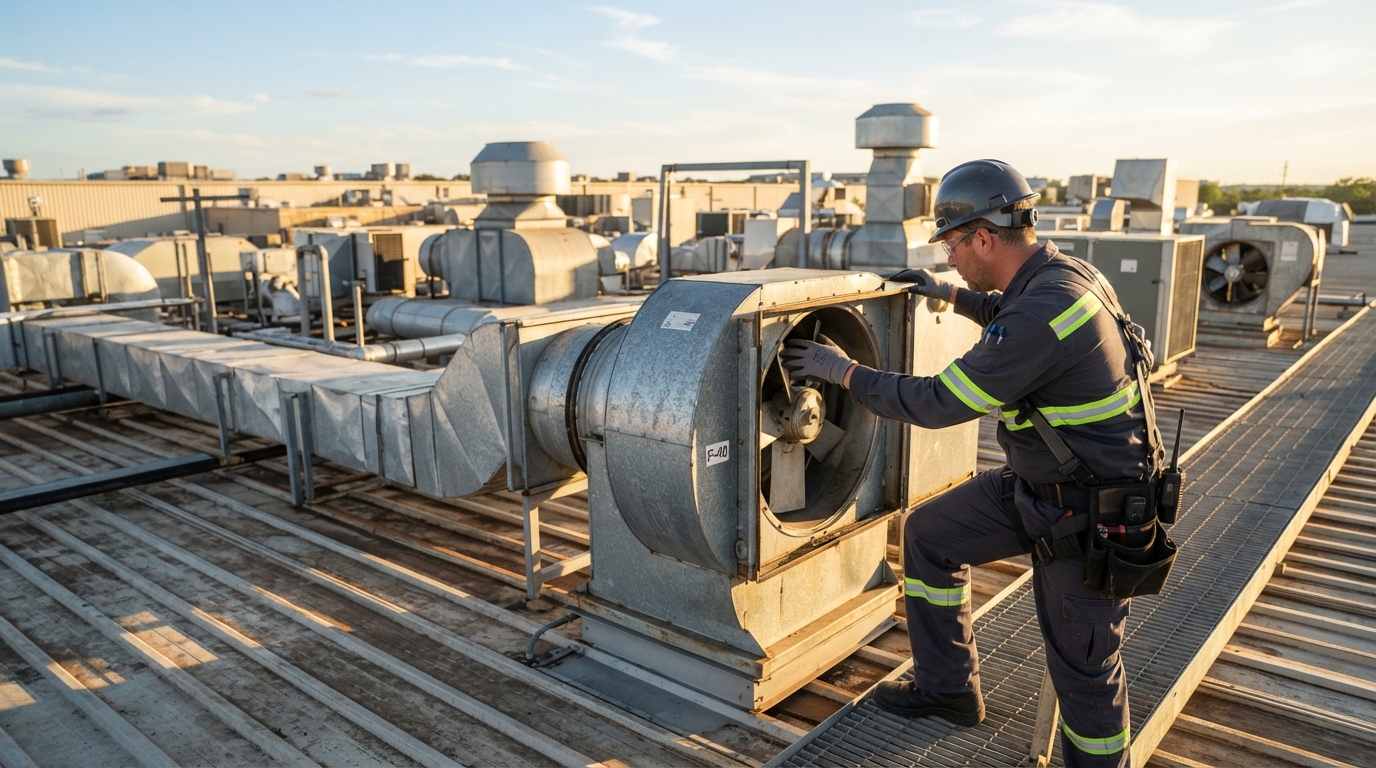
- Upgrading industrial ventilation fans involves matching airflow capacity, duct design, and motor specifications to the facility’s actual contaminant load.
- OSHA’s general industry ventilation standards guide minimum airflow and maintenance intervals for mechanical exhaust systems.
- Equipment selection depends on facility size, contaminant type, and whether local exhaust or general dilution ventilation is required.
A facility upgrading its air handling equipment needs to confirm airflow capacity, duct compatibility, and contaminant-specific exhaust requirements before replacing any unit. Mismatched fan sizing or duct design is a common reason upgrades fail to resolve air quality complaints.
Selecting new Industrial Ventilation Fans starts with an honest assessment of what the current system is failing to do. A fan that moves too little air leaves fumes, dust, or heat trapped in the workspace, while an oversized unit wastes energy and can create uncomfortable drafts or noise. Facility managers typically begin by measuring existing airflow against the square footage, ceiling height, and type of contaminant generated on the floor.
Signs Your Current System Needs Replacement
Older exhaust fans rarely fail all at once. Instead, performance declines gradually until a complaint, inspection, or energy bill forces action.
Common warning signs include:
- Persistent odors, haze, or visible dust that lingers after shifts end
- Unusual motor noise, vibration, or belt wear during normal operation
- Energy costs rising without a corresponding increase in production
- Difficulty meeting air change requirements during facility inspections
- Corrosion or physical damage to housings, blades, or ductwork
Any one of these can indicate the blower or motor is undersized for current operations, especially if the facility has added equipment or expanded floor space since the original system was installed.
Matching Fan Type to Facility Needs
Industrial ventilation falls into two broad categories, and choosing the wrong one is a frequent cause of underperformance after an upgrade.
|
Ventilation Type |
Best Suited For |
Key Consideration |
|
Local Exhaust |
Welding, grinding, chemical processes |
Captures contaminants at the source before they spread |
|
General (Dilution) |
Warehouses, large open floor plans |
Relies on overall air changes per hour |
|
Roof-Mounted Exhaust |
Heat and fume removal in high-ceiling buildings |
Requires correct static pressure rating |
|
Inline/Centrifugal Blowers |
Ducted systems with longer runs |
Needs accurate duct sizing to maintain CFM |
Facilities that generate concentrated contaminants from a specific process, such as welding or abrasive blasting, generally need local exhaust systems rather than relying on dilution alone. According to OSHA’s ventilation hazard recognition guidance, several existing OSHA standards and technical manuals address airflow evaluation, health effects, and system investigation methods for general industry workplaces.
Compliance and Maintenance Considerations
Mechanical ventilation systems are subject to maintenance expectations under general industry regulations, and upgrades should account for ongoing inspection needs rather than just initial installation.
Key factors to review before finalizing an upgrade:
1. Duct diameter and layout compatibility with the new fan’s rated CFM output
2. Motor horsepower relative to static pressure losses across the full duct run
3. Noise output in occupied work areas, particularly near workstations
4. Accessibility for routine inspection and belt or bearing replacement
5. Electrical load requirements if replacing a single-phase unit with three-phase equipment
A facility operating in the USA should also confirm that replacement equipment aligns with any state or local fire code requirements layered on top of federal ventilation standards, since some contaminants trigger additional explosion-prevention rules.
Frequently Asked Questions
How do I know what size fan my facility needs? Sizing depends on room volume, required air changes per hour, and the type of contaminant present, which is typically calculated using CFM requirements specific to the process generating heat, dust, or fumes.
Can an existing duct system be reused with a new fan? Sometimes, but only if the duct diameter and layout match the new unit’s airflow and static pressure ratings; mismatched ducting is a common cause of reduced performance after installation.
How often should industrial ventilation systems be inspected? Inspection frequency depends on the applicable standard and contaminant type, with some general industry ventilation systems requiring testing on a recurring schedule to confirm continued effectiveness.
Is local exhaust always better than general ventilation? Not necessarily; local exhaust is generally preferred when a specific process generates concentrated contaminants, while general dilution ventilation can be sufficient for larger open spaces without a single contaminant source.
Ventilation equipment sourcing, including commercial and industrial fans, blowers, and related air moving equipment, is listed under Brooklyn Fan & Blower Sales Co’s business profile, which serves the New York Metro area from its Woodside location.
Published details for Brooklyn Fan & Blower Sales Co are available for facilities reviewing air handling equipment options.