
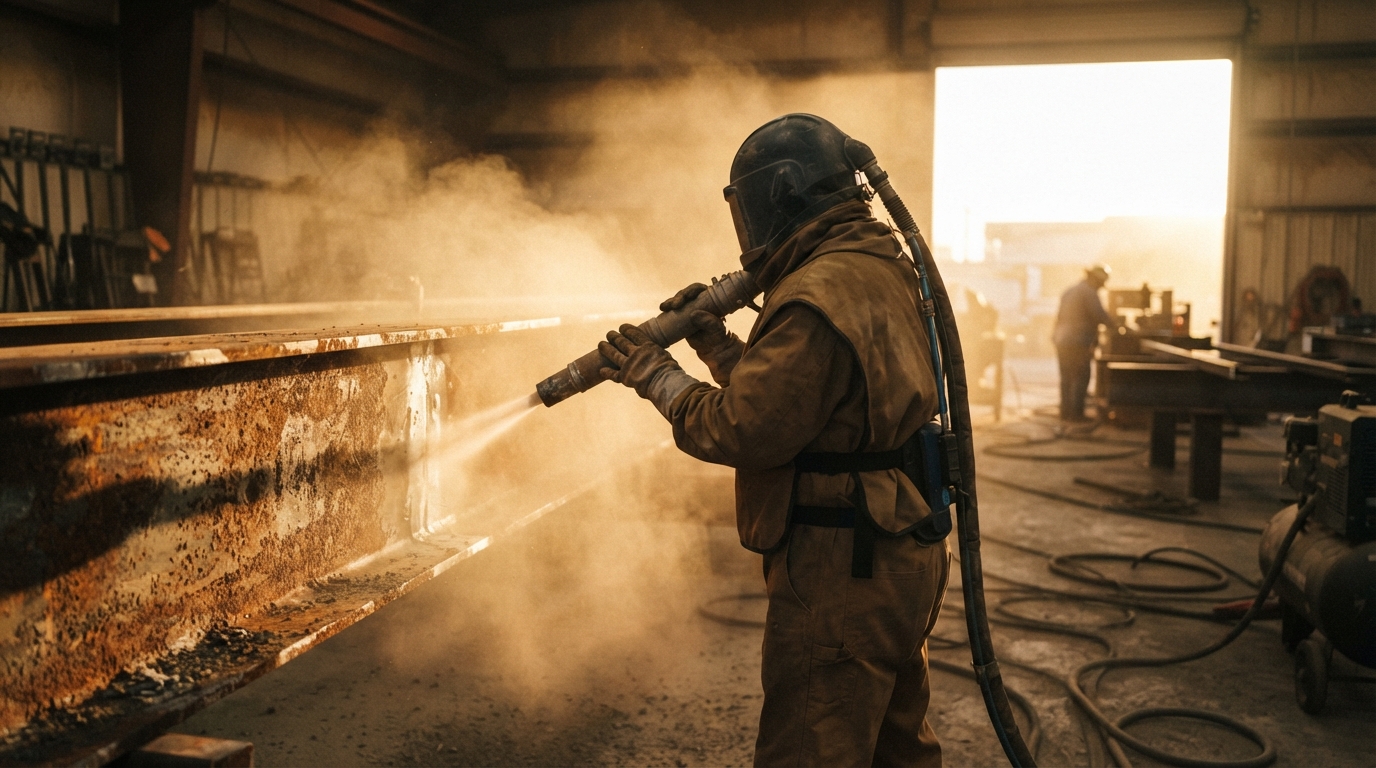
Summary:
-
Blasting in Mesa requires matching abrasive media and equipment to the substrate, contamination level, and required surface profile before work begins.
-
Regional factors like heat, dust, and Mesa’s automotive, construction, and pool-tile industries shape equipment and media choices.
-
OSHA standards govern respiratory protection, ventilation, and exposure limits for any abrasive blasting operation.
Planning a surface preparation project in Mesa starts with identifying the substrate, the contamination to be removed, and the surface profile a coating manufacturer requires, then selecting abrasive media and equipment that match those specifics. Getting this sequence right the first time prevents wasted material, rework, and coating failures down the line.
Mesa’s surface prep demand comes from a mix of sources. Mesa is one of the most active East Valley markets for surface preparation, driven by automotive restoration shops, commercial construction along Loop 202, fabrication facilities near Gateway Airport, and a dense residential pool market where Arizona’s hard water builds calcium scale on tile waterlines every season. Anyone sourcing blasting equipment or media locally is working within that same set of regional pressures, from heat-driven job scheduling to dust control near residential areas.
Matching Media to the Job
Selecting the wrong abrasive is one of the most common and costly mistakes in surface prep. The right choice depends on three factors working together.
-
Substrate and contamination level. Determine the base material, whether steel, concrete, aluminum, or masonry, and assess the extent of rust, mill scale, old coatings, or corrosion, since the type and severity of contamination directly influence the abrasive choice.
-
Required surface profile. Project specifications or coating manufacturer guidelines establish the necessary anchor profile measured in mils, and most industrial coatings require a 2.0 to 3.5 mil profile for optimal adhesion.
-
Media hardness and recyclability. A full-line distributor’s inventory typically spans steel grit, steel shot, aluminum oxide, garnet, crushed glass, and slag-based abrasives, each selected for hardness, recyclability, and consistency.
Verification tools matter too. Profile checks commonly rely on replica tape and profilometers to verify results and ensure compliance with SSPC-SP or NACE standards.
Equipment Choices for Different Project Scales
Equipment selection should follow the same logic as media selection: match capacity to the actual workload rather than defaulting to the biggest or smallest option available.
-
Contractor blast machines for high-volume industrial jobs, such as structural steel prep along major corridors.
-
Blast cabinets for contained work on smaller parts and automotive components.
-
Nozzles, hoses, couplings, and replacement parts to keep existing setups running.
-
Personal protective equipment, including hoods and safety gear, for operator protection during any blasting session.
Stocking equipment to match both occasional-use and contractor-grade workloads covers everything from large fabrication jobs to smaller detail work. A pool contractor removing calcium scale from tile has very different equipment needs than a shop stripping paint from structural steel, even though both fall under the same general service category.
Safety and Compliance Considerations
Abrasive blasting carries recognized occupational hazards that go beyond simple dust and noise. According to the OSHA Fact Sheet on abrasive blasting materials, engineering controls such as substitution, isolation, containment, and ventilation are the primary means of reducing airborne hazard exposure during blasting operations, alongside administrative controls and personal protective equipment.
Key compliance points for any crew planning a project include:
-
Operators working inside blasting rooms or enclosures need proper respiratory protection, since operators working inside abrasive blasting rooms must be protected by hoods and Type CE NIOSH certified abrasive blasting airline respirators, or by positive-pressure blasting helmets.
-
Enclosures need sufficient airflow, because blasting rooms should have sufficient ventilation to provide good operator visibility, prevent dust from settling and accumulating, reduce dust concentrations so PPE provides adequate protection, and prevent the escape of contaminants into adjacent areas.
-
A pre-job hazard review helps catch site-specific risks, since OSHA also recommends inspecting the worksite for hazards such as noise, static electricity, confined spaces, and heat.
Comparing Common Equipment Options
|
Equipment Type |
Best Suited For |
Typical Scale |
|
Contractor blast machine |
Structural steel, large fabrication jobs |
High-volume industrial |
|
Blast cabinet |
Automotive parts, small components |
Contained, repeat use |
|
Pressure pot setup |
Occasional or DIY surface prep |
Small to mid-size jobs |
|
Replacement nozzles/hoses |
Maintaining existing equipment |
Any scale |
FAQ
What determines which abrasive media to use for a project? The substrate type, the level of contamination such as rust or old coatings, and the surface profile a coating manufacturer specifies all factor into media selection, since the type and severity of contamination directly influence the abrasive choice.
Why does surface profile matter so much? Coating adhesion depends on an anchor profile within a defined range, and most industrial coatings require a 2.0 to 3.5 mil profile for optimal adhesion.
Is respiratory protection always required for blasting work? It depends on the setup and enclosure, but operators inside blast rooms or working without separation from the nozzle generally need supplied-air respiratory protection under OSHA guidance.
Does Mesa have unique conditions that affect blasting projects? Yes. Automotive restoration shops, commercial construction along Loop 202, fabrication near Gateway Airport, and a residential pool market dealing with hard-water calcium scale all shape local demand and equipment needs.
Planning a blasting project in Mesa comes down to matching the right media and machine to the substrate, respecting the surface profile a coating requires, and following established safety practices from the start. For sourcing abrasives, equipment, or technical guidance on a specific project, Pecks Coating Supply Co. serves contractors and facility managers across the Phoenix and East Valley area.