
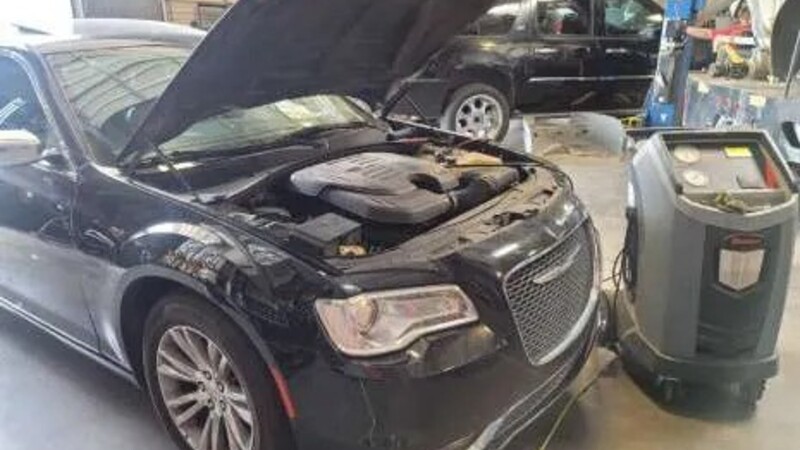
The AC condenser is a heat exchanger at the front of a vehicle that releases heat from the air conditioning refrigerant to the outside air, and the cooling fans pull air across it when the vehicle is moving slowly or stopped. Together, they’re responsible for getting heat out of the system, so servicing them takes pressure testing, electrical diagnostics and refrigerant equipment that only trained technicians use.
For drivers in Goodyear, AZ, these components face some of the toughest conditions in the country. Here’s how they work and how professionals service them.
Where Does the Heat From a Car’s Cabin Go?
An automotive air conditioning system doesn’t create cold air. It moves heat from inside the cabin to the outside:
-
Inside the dashboard, the evaporator absorbs heat from the cabin air.
-
The compressor pressurizes the refrigerant, which raises its temperature.
-
At the front of the vehicle, the condenser releases that heat to the outside air.
-
The refrigerant then returns to the evaporator to absorb more heat.
If the condenser can’t release enough heat, the whole system has less capacity to cool the cabin.
How Does the AC Condenser Work?
The condenser usually sits directly in front of the engine radiator. It’s made of thin tubes and fins, typically aluminum, that give it a large surface area for releasing heat.
Hot, high-pressure refrigerant vapor enters the condenser from the compressor. As outside air passes over the fins, the refrigerant gives up its heat and changes from a vapor into a liquid. That liquid then moves on toward the expansion device and evaporator.
Many systems also include a receiver-drier or accumulator, which holds a moisture-absorbing material called desiccant to help keep the refrigerant clean and dry.
What Do the Cooling Fans Do?
At highway speeds, air flows naturally through the condenser and radiator. At low speeds, in traffic or at idle, there isn’t enough natural airflow, so the cooling fans take over.
On most modern vehicles, electric fans are controlled by the engine computer or a dedicated fan module. They respond to inputs such as:
-
Refrigerant pressure, read by a sensor in the AC system
-
Engine coolant temperature, since the same fans often cool the radiator
-
AC system demand, based on whether the air conditioning is on and how hard it’s working
Some trucks use an engine-driven fan with a clutch instead of, or in addition to, electric fans. Either way, the fans keep air moving across both the condenser and the radiator.
Why Do These Components Work So Hard in Goodyear, AZ?
The condenser can only release heat when the outside air is cooler than the refrigerant. In Goodyear’s summer heat, that temperature difference is smaller, so the condenser and fans have to work harder to do the same job.
Stop-and-go traffic adds to the load, since the fans carry most of the airflow when the vehicle isn’t moving fast. The condenser’s position at the front of the vehicle also exposes it to dust, insects and road debris. These conditions are part of everyday driving in the West Valley, and they’re why the system benefits from regular professional inspection.
How Do Professionals Service the Condenser and Fans?
Condenser and cooling fan work combines refrigerant handling, electrical diagnostics and mechanical repair. Professional automotive AC repair typically includes:
Performance and Pressure Testing
Technicians measure system pressures and vent temperatures and compare them with the manufacturer’s specifications and outside conditions. This shows how well the system is releasing heat.
Fan Operation Checks
Using a scan tool, technicians can command the cooling fans on and off and check their speed settings. They also test the related relays, modules, wiring and sensors.
Leak Detection
Because the condenser sits at the front of the vehicle, it’s inspected closely for leaks using electronic detectors or UV dye.
Refrigerant Recovery and Recharge
When AC system components are opened or replaced, the refrigerant must be recovered with approved equipment. Federal rules under Section 609 of the Clean Air Act require technicians who service vehicle air conditioning for pay to be certified. After repairs, the system is placed under vacuum to remove air and moisture, then recharged with the correct type and amount of refrigerant.
Related Components
Depending on the repair, manufacturers may call for replacing the receiver-drier or accumulator and following specific procedures for system cleanliness.
When Should the AC System Be Inspected?
Reduced cooling, especially at idle or in traffic, unusual fan noises, warning lights, or changes in how the engine temperature gauge behaves should be inspected by a professional rather than left to guesswork. A shop that provides AC Auto Repair can evaluate the condenser, fans and the rest of the system, explain what they find and recommend service based on the vehicle’s specifications.
Keeping Car AC Systems Working in Goodyear, AZ
The condenser and cooling fans are where an air conditioning system finally gets rid of the heat it removes from the cabin. For drivers looking for local auto AC repair in Goodyear, AZ, professional car AC repair that covers the whole system, not just one part, is the most dependable way to keep cooling performance steady through long, hot summers. Regular auto air conditioning repair and inspection helps the system keep up with West Valley heat year after year.