
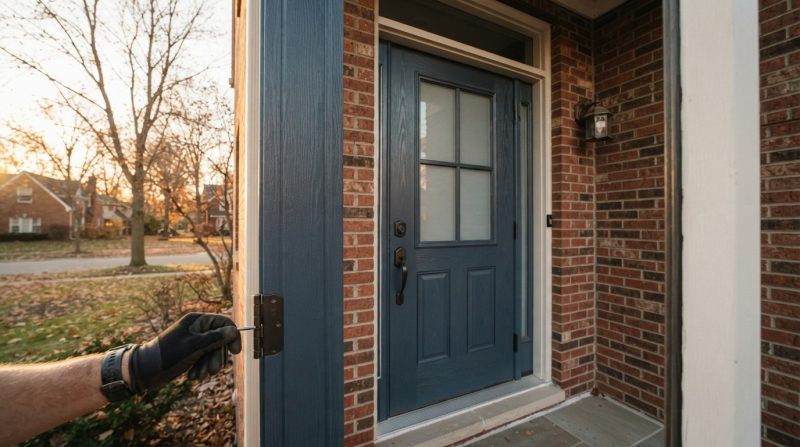
A wood front door that has been stained or refinished several times needs careful evaluation because previous coatings can affect surface preparation, color development, and the appearance of the underlying wood. Professional refinishing generally involves removing the old coating before preparing the existing wood so the new stain and protective finish can be developed from a more appropriate starting point.
For Phoenix homeowners, an older entry door may have gone through several maintenance or refinishing cycles over its lifetime. One homeowner may have added a maintenance coat years ago. Another may have had the door completely refinished. A previous property owner may have chosen a darker stain or applied a different type of protective coating.
By the time the current homeowner considers front door restaining, the visible surface may reflect years of work rather than a single original finish.
Understanding that history helps explain why an older wood door should be evaluated based on its current condition instead of assuming that another coat can simply be applied over what is already there.
Are There Really Multiple Layers of Stain on an Older Door?
Not always in the way homeowners might imagine.
When people refer to multiple “stain layers,” they may actually be looking at a combination of stain, protective finish, maintenance coatings, and materials left from previous refinishing work.
Stain and protective finish perform different jobs. Stain contributes color to the wood, while the protective finish forms the exterior layer that helps protect the surface.
Over time, a wood door that has been maintained or refinished repeatedly can develop a complicated coating history. Some areas may contain more remaining finish than others. Sections exposed to stronger sunlight may look substantially different from protected areas. Previous work may also have changed the color without completely removing evidence of an earlier treatment.
That history becomes important when evaluating the door for another refinishing project.
Why Can’t Another Coat Simply Be Added?
Sometimes maintenance is appropriate, but adding material over an aging surface is not the same as completing a full refinishing project.
A maintenance coat can be useful when the existing finish is still in a suitable condition and the chosen finish is maintainable. However, when the coating is substantially worn, deteriorated, uneven, or affected by previous refinishing cycles, the door may require a more complete process.
Applying new material over an unsuitable existing surface does not resolve what is underneath it.
For example, consider a front door that appears much darker around recessed panels than across the broad center sections. Adding more stain without first understanding the existing coating may make those differences more noticeable rather than creating a coordinated appearance.
This is one reason professional front door refinishing begins with evaluating the door that is actually present, including its current coating and condition.
What Can Previous Refinishing Hide?
Older coatings can make it difficult to judge the underlying wood from appearance alone.
Once previous finish begins to deteriorate, a homeowner may see:
-
Uneven coloration
-
Areas that appear darker than surrounding wood
-
Dull sections next to glossier sections
-
Residue in recessed details
-
Fading across exposed portions
-
Differences between protected and unprotected areas
-
Evidence of older repairs or previous surface work
Some of these characteristics become easier to understand once the existing coating is removed.
That does not mean stripping will reveal perfectly uniform wood. Natural grain, age, environmental exposure, prior work, and the characteristics of the wood itself may all remain part of the finished appearance.
The purpose of evaluation is to understand those conditions before setting unrealistic expectations for wood front door restoration.
Why Is Removing the Existing Finish Important?
When a door requires complete refinishing, removing the old finish gives the refinisher access to the underlying surface.
A professional process typically involves stripping the existing finish before sanding. That sequence matters because sanding should primarily prepare the exposed wood rather than being relied upon to grind through layers of old coating.
This becomes especially relevant on doors that have been worked on multiple times.
If old coating remains unevenly distributed across panels, corners, edges, or detailed areas, those differences can affect preparation and color development. Removing the coating provides a clearer view of the condition underneath and allows the wood to be prepared more deliberately.
For homeowners considering professional front door refinishing, the important point is that refinishing is more involved than putting another color over an aging surface.
Can Previous Stain Affect the New Color?
Yes. Previous color history is one of several factors that may influence the final appearance.
Even after an old finish has been removed, wood does not become a completely blank manufactured surface. Earlier stain, age, grain characteristics, previous sun exposure, and repairs can all contribute to how the wood looks and how a new color develops.
For that reason, exact stain matching should be approached cautiously.
A professional refinisher can work with colors and tints to get as close as reasonably possible to the desired appearance, but “matching” can create unrealistic expectations. Wood can respond differently from one section to another, and the same color can appear different as lighting changes.
This becomes especially important when refinishing a wood front door that must coordinate with surrounding trim, interior woodwork, or architectural features.
Why Might One Section Stay Darker Than Another?
Different parts of the same door can have different histories.
Imagine a paneled front door that has been refinished several times. The broad, outward-facing sections may have received more environmental exposure, while recessed sections remained somewhat protected.
Over the years, those areas may weather at different rates.
Previous coatings can also collect differently around profiles, corners, and recessed details. If an earlier refinishing project did not treat every area the same way, variations may remain underneath the newest finish.
Natural wood variation adds another factor. Grain patterns and density are not perfectly identical across the entire door.
As a result, homeowners should not assume that every section will look exactly the same once the door is restained. A coordinated finished appearance is a more realistic goal than artificial uniformity.
Do Multiple Old Finishes Damage Decorative Details?
Previous refinishing does not automatically mean decorative details are damaged, but detailed areas deserve careful attention.
Raised panels, shaped profiles, borders, and recessed sections can hold coating differently than broad flat surfaces. When several refinishing cycles have occurred, buildup may be more noticeable around some of these features.
Careful stripping and preparation are therefore important.
Trying to remove everything primarily through aggressive sanding can unnecessarily alter edges, soften profiles, or remove more wood than needed. The goal is not to flatten the existing craftsmanship. It is to remove the worn coating and prepare the wood while respecting the door’s original form and character.
This distinction is particularly relevant to older or more detailed entry doors where preserving the existing features is part of the purpose of restoration.
What If the Door Has Been Restained Several Different Colors?
A history of different stain colors can make the next project more complex, especially if one previous color was substantially darker than another.
The underlying wood may retain color variation even after surface coatings are removed. Some areas may also react differently based on previous exposure and preparation.
This does not necessarily prevent refinishing.
It does mean the desired new color should be discussed in relation to the current door rather than chosen with the assumption that every wood surface can be made to look identical to a small sample.
A lighter desired appearance may present different considerations from moving toward a darker tone. The condition and existing color history need to be evaluated first.
This is another reason front door restaining is better approached as work on an existing material rather than as a simple color swap.
Can the History of the Door Always Be Identified?
No.
Homeowners do not always know what previous owners or contractors used on a door. Even when they know that the door was refinished before, they may not know what products were applied or how the surface was prepared.
That is common.
A useful professional evaluation can therefore focus on what can actually be observed: the existing coating, the condition of the wood, visible wear, exposure, construction details, and the homeowner’s desired result.
If previous invoices or product information happen to be available, they may provide additional context, but they are not always necessary simply to begin evaluating the door.
Clear photographs of the full entry and close-ups of problem areas can also help a refinisher understand the starting condition.
Does an Older Refinishing History Mean the Door Cannot Be Restored?
Not necessarily.
The number of times a door has previously been stained or refinished is only one consideration. The present condition of the existing wood is more important than simply counting previous projects.
A wood door may still be a reasonable candidate for wood front door restoration even if it has received several earlier finishes. Conversely, a door with only one previous coating may have other condition concerns that require careful evaluation.
Important considerations include:
-
The condition of the wood
-
The state of the existing finish
-
Evidence of previous repairs
-
Environmental exposure
-
Decorative details and profiles
-
The desired stain appearance
-
Differences in condition across the door
A professional assessment should consider these factors together rather than making a decision based on the age of the door alone.
Does the Door Need to Be Removed for Full Refinishing?
For the best results during complete refinishing, the existing door is generally removed.
Removal allows better access to the surfaces and edges during stripping, sanding, repair work, staining, and application of the protective finish.
Once the work is complete and the finish is ready, the existing door can be carefully rehung or reinstalled within its existing opening so it is properly aligned in the frame.
Maintenance coats and minor touch-ups may sometimes be completed while the door remains in place when appropriate.
For a typical single door, refinishing can often be completed in one day. Larger or more involved projects may require additional time.
What Should Phoenix Homeowners Consider Before Restaining an Older Front Door?
The most useful first step is to look beyond color.
A homeowner may initially think, “The stain looks faded, so it needs another stain coat.” But the more important questions involve the condition beneath that appearance.
Consider:
Has the door been refinished before?
Even incomplete information can help establish that previous coatings may be present.
Is the wear consistent across the door?
Differences between panels, edges, recessed areas, and exposed sections can provide useful information.
Is the protective finish still intact?
A maintenance situation is different from a surface that requires full refinishing.
Are decorative features still well defined?
Profiles and details should be considered during surface preparation.
Is an exact color being expected?
Wood, previous stain history, and changing light can make exact matching unrealistic.
What result is actually desired?
Knowing whether the goal is to stay close to the existing tone or move toward a different appearance helps guide the conversation.
Phoenix conditions also make environmental exposure relevant. Sun, heat, dry air, dust, and seasonal weather can affect exterior wood surfaces differently depending on the door’s orientation and protection.
Multiple Old Finishes Call for Evaluation, Not Guesswork
A front door with several previous staining or refinishing cycles is not simply a surface waiting for another coat. Its current appearance may reflect old protective finishes, earlier stain colors, environmental exposure, natural wood characteristics, previous preparation, and years of everyday use.
Careful evaluation helps determine what is actually present before the next refinishing process begins. For homeowners, that means setting realistic expectations about preparation and color while preserving as much of the character of the existing wood door as its condition allows.
About Desert Rose Door
Desert Rose Door is based in Tempe, Arizona, and provides residential and commercial door refinishing and wood restoration services throughout Phoenix and surrounding communities. They are licensed, bonded, and insured under Arizona ROC #215615 and can be reached at 480-272-7074; those planning an evaluation can also find their office on Google Maps.