
In brief:
• A qualified heat treating equipment manufacturer should demonstrate furnace construction standards, documented temperature control, and responsive technical support.
• Equipment choice should match the specific thermal process, not just maximum temperature capability.
• Local service availability and decades of manufacturing experience are practical indicators of long-term reliability.
Choosing the right supplier starts with matching equipment capability to your actual thermal process, then verifying that the company backs its products with real engineering support and service after the sale. Buyers who skip this step often end up with furnaces that run hot, cool unevenly, or lack the controls needed for repeatable results.
Finding a dependable Heat Treating Equipment Manufacturer means looking past price lists and comparing how each company builds, tests, and supports its furnaces over time. Construction details such as insulation type, door design, and control instrumentation directly affect how consistently a furnace performs across repeated cycles.
Why Furnace Construction Details Matter
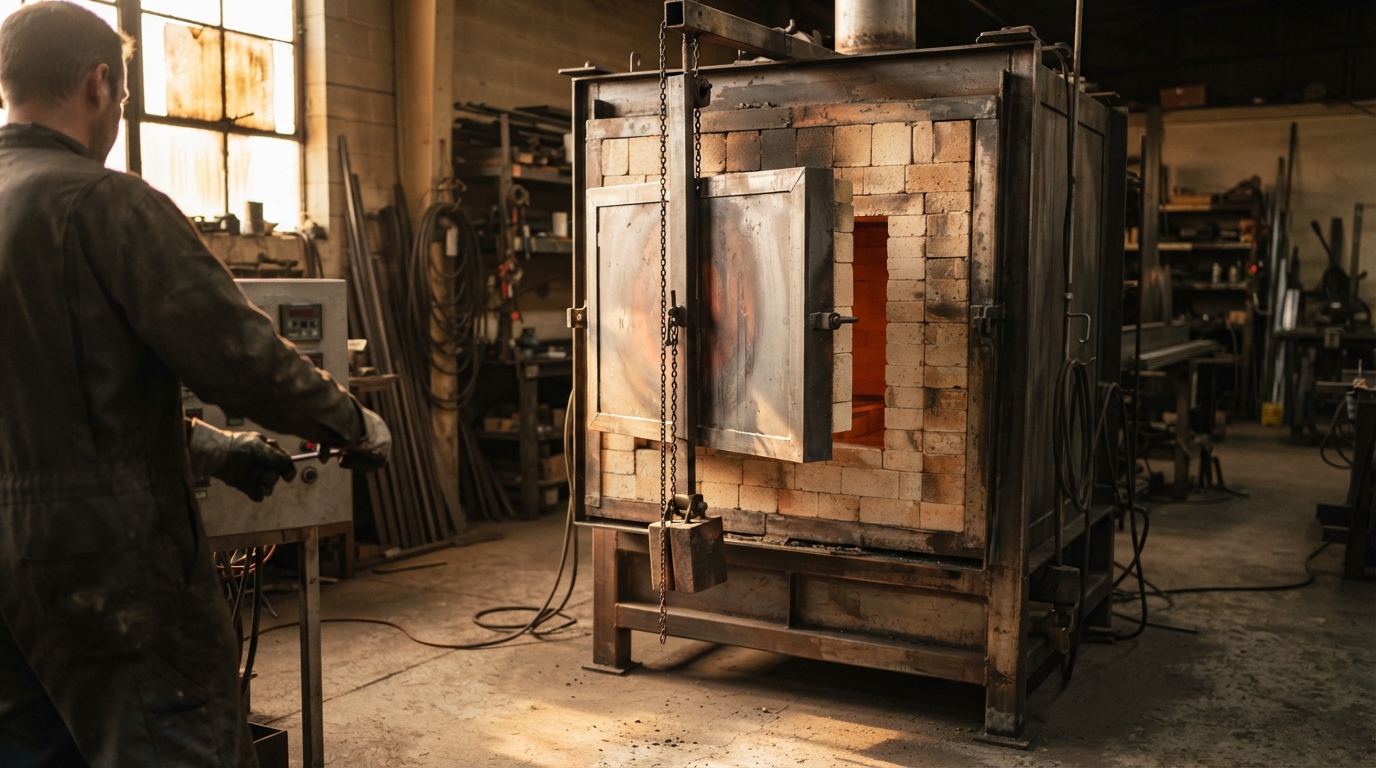
Industrial furnaces are not interchangeable boxes that simply reach a target temperature. The physical build determines how well heat is retained, how workloads are accessed, and how the equipment holds up through continuous use.
• Insulation mass and type affect ramp speed and temperature recovery after the door opens.
• Door construction influences heat loss and how efficiently workloads load and unload.
• Hearth and chamber materials need to withstand repeated thermal cycling without breaking down.
A furnace built with heavier firebrick mass tends to hold stable temperatures better, while hybrid brick-and-fiber insulation designs are suited to faster ramping and quicker recovery between loads.
Matching Equipment to the Actual Process
A common buying mistake is selecting a furnace based only on maximum rated temperature. The treatment process itself, including soak time, cooling method, and material type, should drive the specification.
1. Identify the specific process: hardening, annealing, carburizing, stress relieving, or tempering.
2. Confirm workload dimensions and required chamber capacity.
3. Determine whether integrated quenching, such as a roll-out quench tank, is needed for the transition from heat to cool.
4. Match control instrumentation to the uniformity and documentation requirements of the application.
For operations tied to aerospace or other regulated thermal processing work, furnace design and recordkeeping often need to align with recognized pyrometry standards. The National Institute of Standards and Technology maintains calibration guidance that many heat treating facilities reference when verifying temperature sensors and instrumentation accuracy. Manufacturers who understand these documentation expectations are better positioned to supply equipment that holds up to audit scrutiny.
Comparing Furnace Features Before You Buy
|
Feature |
Lower-End Equipment |
Higher-Spec Equipment |
|
Insulation |
Thin firebrick or basic liner |
Thick firebrick or hybrid brick-and-fiber |
|
Temperature Control |
Analog dial, single sensor |
Digital controls, multi-zone sensing |
|
Door Design |
Manual swing, limited sealing |
Counterbalanced or vertical, tighter seal |
|
Quench Integration |
Separate, manual transfer |
Roll-out quench tank, integrated setup |
This comparison is a general guide rather than a guarantee of performance, since actual specifications vary by manufacturer and model.
Evaluating Manufacturer Support and Service
Equipment quality only tells part of the story. Ongoing support determines whether a furnace stays productive for years rather than becoming a maintenance burden.
• Ask whether the manufacturer offers direct consultation on workload, temperature, and process before quoting equipment.
• Check whether replacement parts and components are readily available rather than requiring long lead times.
• Confirm whether the company manufactures domestically, which can simplify service calls and parts sourcing.
• Look for a documented history of serving the specific industries relevant to your operation, such as metalworking, foundries, or trade schools.
A manufacturer with decades of continuous production experience has typically encountered a wide range of application challenges, which can translate into more practical guidance during the selection process.
Frequently Asked Questions
What is the difference between a heat treating furnace and a melting furnace? A heat treating furnace is designed to modify the properties of a material, such as hardening or annealing steel, without melting it, while a melting furnace raises material past its melting point for casting or processing in liquid form.
How do I know what furnace size I need? Furnace sizing depends on workload dimensions, batch volume, and the specific thermal process, so measuring the largest parts you intend to treat and confirming required soak times are good starting points before requesting a quote.
Does a gas-fired furnace work for all heat treating applications? Gas-fired furnaces support many common processes including hardening, annealing, and stress relieving, but the right fuel type and burner configuration depend on temperature range, chamber size, and available gas supply at the facility.
Why does door design matter for furnace performance? Door construction affects how much heat escapes during loading and unloading, which influences both energy efficiency and how consistently the chamber returns to target temperature between cycles.
Evaluating a heat treating equipment supplier comes down to verifying real construction quality, confirming the equipment matches your specific process, and checking that support continues after installation. Buyers who ask detailed questions about insulation, controls, and service history are better equipped to avoid costly mismatches. Charles A. Hones, Inc. has manufactured heat treating furnaces and related combustion equipment since 1911, and additional details on current furnace models and configurations are available through its Charles A. Hones, Inc. product listings.