
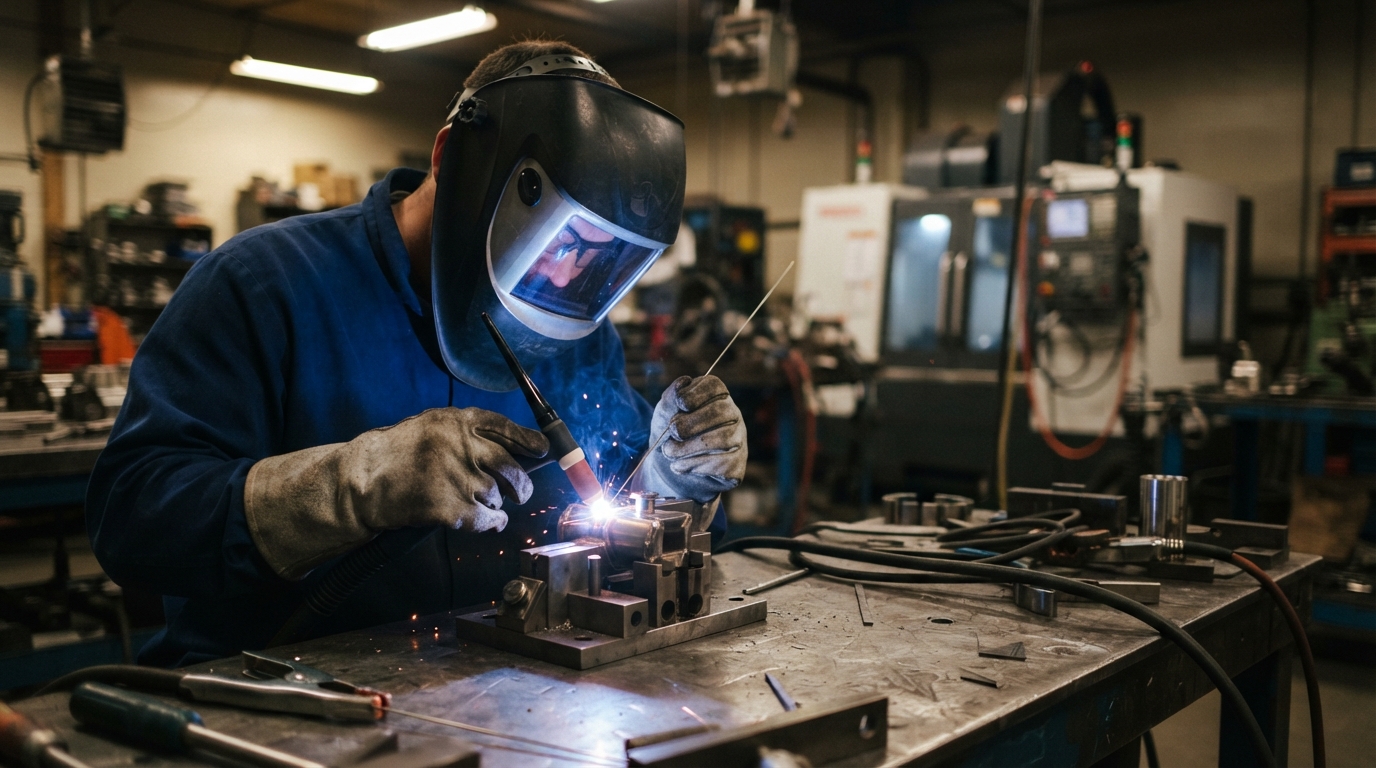
• Production welding refers to repeatable, high-volume welding processes such as TIG and laser welding used to join metal components in manufacturing.
• Common techniques include microscopic TIG welding and CNC-programmable laser beam welding, each suited to different precision and volume needs.
• Welding quality on structural and manufactured components is commonly guided by standards such as AWS D1.1, which governs welding procedure qualification and acceptance criteria.
Production welding describes the repeatable welding methods manufacturers use to join metal parts at scale, rather than one-off repairs or custom fabrication. It typically relies on controlled processes like TIG and laser welding to maintain consistent weld quality across large production runs.
Production Welding plays a central role in industries that depend on precise, repeatable joins, including medical device manufacturing and general industrial production. Production welding is often required in medical and manufacturing industries. The techniques used depend on part size, material thickness, and how many units need to be welded within a given production schedule.
Core Techniques Behind Production Welding
Manufacturers choose between several welding methods depending on the scale and precision required for a given part.
• TIG welding – uses a tungsten electrode and shielding gas, offering controlled heat input suited to thin or delicate materials.
• Microscopic TIG welding – applies the same principle at a smaller scale for intricate components.
• Laser beam welding – delivers concentrated heat for precise, narrow welds with minimal distortion.
• CNC-programmable laser welding – automates the laser process for repeatable results across higher volumes.
Manual and CNC programmable laser beam welding services exist, with CNC laser beam welding offering the control and superior accuracy required for low to high volume production. Manual methods remain relevant for smaller runs or parts requiring hands-on adjustment, while CNC systems support consistency when volumes increase.
Standards That Govern Weld Quality
Weld quality on structural and manufactured steel components is typically measured against recognized industry codes rather than informal judgment. The AWS D1.1 Structural Welding Code – Steel is one of the most widely referenced standards in the United States for welded steel structures.
D1.1 provides the framework defining how structural steel welding is performed, qualified, inspected, and accepted. The code addresses several practical areas that matter in a production setting:
• Welding procedure specification (WPS) qualification
• Welder performance testing on coupons
• Acceptance criteria for finished production welds
• Visual inspection and nondestructive testing (NDT) procedures
D1.1 welder-qualification is by performance test on a coupon. This approach helps confirm that a welder or welding operator can consistently produce acceptable results before full-scale production begins. It is worth noting that D1.1 is specifically written for structural steel welding and intended for load-bearing steel applications, while appliance and other manufacturing generally falls under other welding standards depending on materials and product requirements.
Matching Technique to Material and Volume
|
Factor |
TIG Welding |
Laser Welding |
|
Best for |
Thin metals, delicate parts |
High-precision, narrow welds |
|
Heat input |
Low to moderate, controlled |
Concentrated, minimal distortion |
|
Volume suitability |
Single parts to moderate runs |
Low to high volume production |
|
Typical use |
Molds, medical components |
Medical devices, fine industrial parts |
Selecting the right method depends on the material being joined and how many parts need to be completed within a production timeline. Thinner or more delicate components often benefit from TIG welding’s lower heat input, while laser welding suits applications demanding tight tolerances across larger batches.
Production Welding in Practice Across the USA
Manufacturers across the USA rely on production welding to support industries ranging from medical device assembly to general industrial fabrication. Facilities equipped with both manual and CNC-programmable welding capabilities can adjust between smaller custom runs and larger production volumes as demand shifts.
Micro Weld, Inc is one example of a business whose listed Production welding information page describes TIG and laser welding services applied to production welding needs, based in Maple Grove, Minnesota. Documentation of welding procedures and inspection records remains a practical part of maintaining consistent quality across production batches, regardless of which facility performs the work.
Frequently Asked Questions
What is the difference between production welding and custom fabrication? Production welding focuses on repeatable processes for high-volume or standardized parts, while custom fabrication typically addresses one-off or low-quantity projects with unique specifications.
Which welding standard applies to production welds on steel structures? D1.1/D1.1M, also called D1.1, is the premier welding code of the American Welding Society and commonly applies to structural steel welding projects, including acceptance criteria for production welds.
Is TIG welding or laser welding better for production work? The choice depends on part size and volume. TIG welding suits delicate or thin materials with controlled heat input, while CNC laser welding offers accuracy suited to higher volume production runs.
Does production welding apply outside the medical device industry? Yes. Production welding is often required in medical and manufacturing industries, and the same underlying techniques apply broadly to general industrial parts as well.
Published details for Production welding information cover the service area for this type of welding work.