
Sciatica describes symptoms caused by irritation or compression of nerve roots that contribute to the sciatic nerve, often producing pain, tingling, numbness, or weakness that travels from the lower back or buttock into one leg. A lumbar disc problem is one possible cause, but the location, behavior, and neurological pattern of the symptoms help determine whether a disc may actually be involved.
That distinction is important because not every case of leg pain is sciatica, and not every case of sciatica comes from a herniated or bulging disc.
For someone experiencing recurring leg symptoms in Westfield, NJ, understanding the pattern can make a professional evaluation more useful and help prevent assumptions based solely on an online symptom list.
What Does Sciatica Usually Feel Like?
Sciatica typically affects one side of the body and follows a pathway from the lower back or buttock into the leg.
People often describe the sensation as:
-
Sharp or burning pain
-
An electric or shock-like feeling
-
Tingling or pins and needles
-
Numbness
-
Weakness
-
Pain extending into the calf or foot
Some people also have lower-back pain, but the leg symptoms may be more noticeable.
The exact pattern varies because different lumbar nerve roots contribute sensation and motor function to different areas of the leg.
A sciatica chiropractor assessing these symptoms should therefore look at more than whether the patient simply says, “My leg hurts.”
The location of the symptoms, movements that provoke them, neurological changes, and medical history all provide important context.
When Can a Disc Problem Cause Sciatica?
Intervertebral discs sit between the vertebrae and help distribute load through the spine.
If a lumbar disc bulges or herniates in a way that irritates a nearby nerve root, symptoms may develop along the pathway associated with that nerve.
A herniated disc is one of the most common causes of sciatica. However, other problems can also irritate or compress nerve roots, including spinal stenosis, spondylolisthesis, and other spinal conditions.
This is why identifying sciatica is only one step.
The next question is what is causing the nerve irritation.
Which Symptoms May Suggest Disc Involvement?
No single symptom proves that a disc is responsible, but certain patterns may raise suspicion.
Pain that travels below the buttock
Disc-related nerve-root irritation often produces pain that extends from the lower back or buttock into the thigh, calf, foot, or toes.
This radiating pattern differs from localized muscle soreness that remains confined to the lower back.
Tingling or numbness
Changes in sensation may suggest involvement of a nerve rather than muscle tension alone.
A person might notice tingling along part of the calf, numbness in the foot, or unusual sensation in certain toes.
The exact distribution can help a clinician determine which nerve root may be involved.
Weakness
Weakness can be particularly important.
Someone may notice difficulty lifting the front of the foot, pushing through the toes, climbing stairs, or performing another movement that previously felt normal.
New or worsening weakness should be evaluated rather than dismissed as ordinary soreness.
Symptoms affected by coughing or sneezing
Some people with lumbar disc herniation report that pain intensifies with coughing, sneezing, or straining.
These actions can temporarily increase pressure within the spinal canal and aggravate an already sensitive nerve root.
This feature alone does not confirm a disc injury, but it can add useful information to the overall pattern.
Does Sitting Make Disc-Related Sciatica Worse?
It can for some people.
Prolonged sitting changes loading through the lumbar spine, and individuals with certain disc-related problems may notice that symptoms become more pronounced after sitting for an extended period.
For example, someone might feel relatively comfortable while walking but develop increasing buttock and leg discomfort during a long commute or extended desk work.
Another person may notice symptoms when moving from sitting to standing.
These patterns are worth documenting because they help show how the problem behaves during normal daily activity.
They do not automatically establish a diagnosis.
Can Sciatica Occur Without Much Back Pain?
Yes.
Some people expect a disc-related problem to cause severe lower-back pain first, but that is not always the case.
A person may experience substantial leg pain, tingling, or numbness while reporting relatively little discomfort in the back.
This can happen because the irritated nerve root may produce symptoms farther along its distribution.
That is one reason sciatica can initially be mistaken for a hamstring problem, calf strain, hip issue, or another lower-extremity concern.
A careful history can help distinguish these patterns.
Does Leg Pain Automatically Mean Sciatica?
No.
Pain in the leg can come from many sources.
Muscles, joints, tendons, peripheral nerves, vascular conditions, hip problems, and other issues may produce symptoms that overlap with what people commonly call sciatica.
True sciatica involves irritation or compression of nerve roots contributing to the sciatic nerve.
A professional evaluation can help determine whether the symptom pattern appears consistent with lumbar nerve involvement or whether another source should be investigated.
How Does a Clinician Evaluate Possible Disc-Related Sciatica?
The evaluation often begins with the history.
A clinician may ask:
-
Where did the symptoms first begin?
-
How far down the leg do they travel?
-
Is the pain on one side or both?
-
Is there tingling or numbness?
-
Has strength changed?
-
Does sitting worsen the problem?
-
What happens during bending or lifting?
-
Do coughing or sneezing affect symptoms?
-
Was there a recent injury?
-
Have similar symptoms occurred before?
Physical examination may then assess movement, sensation, strength, reflexes, and other neurological findings.
In some situations, imaging may be clinically appropriate. However, imaging findings still need to be interpreted alongside the patient’s symptoms and examination.
A disc finding on an MRI does not automatically prove that it is causing the pain.
Why Does the Symptom Distribution Matter?
Different nerve roots serve different regions of the leg.
For example, one lumbar nerve-root problem might produce symptoms across part of the outer leg or top of the foot, while another may involve a different distribution.
Clinicians can compare the patient’s symptom map with strength, sensation, and reflex findings to look for consistency.
This does not turn the evaluation into a simple checklist.
People do not always experience textbook symptom patterns, and there can be overlap.
Still, the distribution of pain and neurological symptoms can provide much more useful information than the general statement, “My leg hurts.”
When Might Spinal Decompression Be Considered?
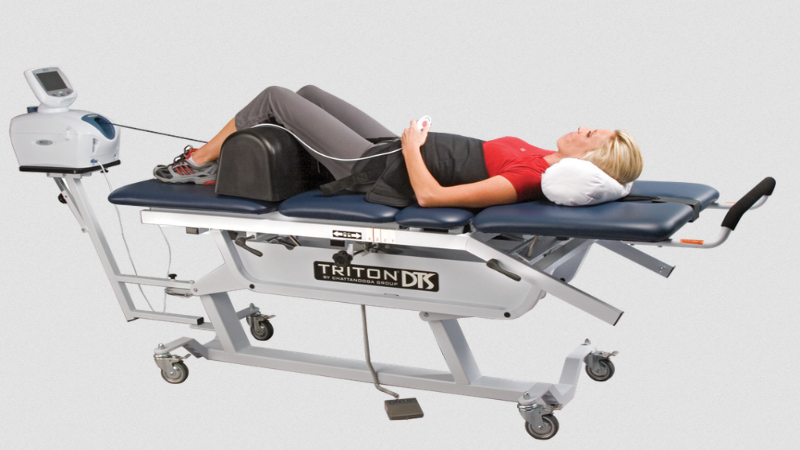
For appropriately evaluated patients, non-surgical spinal decompression may be considered as one conservative approach to certain disc-related spinal complaints.
The treatment uses controlled mechanical traction intended to alter loading on the targeted region of the spine.
Someone researching Sciatica spinal decompression should understand that the presence of sciatica alone does not automatically make decompression appropriate.
Before treatment is considered, the clinician should determine whether the symptoms appear consistent with a condition that may reasonably respond to the approach and whether there are reasons another form of care or medical evaluation should take priority.
Is Spinal Decompression for Disc Injury Appropriate for Everyone?
No.
Spinal decompression for disc injury is not a universal solution for leg pain, back pain, or every type of sciatica.
Different causes require different considerations.
A disc herniation affecting a nerve root presents a different clinical issue from leg symptoms caused by spinal stenosis, a hip problem, or another condition.
Medical history matters as well.
The decision should be based on the full presentation rather than on a keyword, diagnosis label, or imaging phrase.
A responsible spinal decompression chiropractor should also identify when conservative care is not the right starting point.
What If an MRI Shows a Disc Bulge?
A disc bulge on imaging can be relevant, but it should not be treated automatically.
Disc changes can appear in people who have no symptoms.
For that reason, the useful question is not simply, “Is there a bulge?”
It is:
Does the location of the finding reasonably match the patient’s symptoms and examination?
Imagine that an MRI identifies a disc abnormality on one side, but the person’s neurological symptoms consistently appear in a completely different pattern. That mismatch deserves consideration.
Imaging is most useful when it contributes to a coherent clinical picture.
When Should Sciatica Symptoms Be Evaluated Urgently?
Most cases of sciatica are not medical emergencies, but certain neurological symptoms require prompt attention.
Seek urgent medical evaluation for symptoms such as:
-
New difficulty controlling the bladder or bowels
-
Numbness around the groin, genitals, or saddle region
-
Severe or rapidly worsening weakness
-
Significant symptoms affecting both legs
-
Major loss of sensation
-
Symptoms following serious trauma
-
Rapidly progressing neurological changes
These symptoms can indicate significant nerve compression or another condition requiring urgent medical assessment.
People experiencing these warning signs should not delay emergency evaluation while waiting for a routine chiropractic appointment.
Can Symptoms Change During the Day?
Yes.
Sciatica symptoms may vary depending on position, activity, workload, and irritation of the affected nerve.
One person may feel worse after sitting during a long commute.
Another may notice discomfort during bending or lifting.
Someone else may feel relatively comfortable in the morning but experience increasing leg symptoms after several hours of activity.
Tracking these patterns can make an evaluation more informative.
Useful notes include:
-
How long sitting is tolerated
-
Whether walking helps or aggravates symptoms
-
Which movements reproduce the pain
-
Whether numbness comes and goes
-
Whether weakness is changing
-
How far down the leg symptoms travel
The goal is not to self-diagnose. It is to provide clearer information.
What Should Someone Ask During a Sciatica Evaluation?
Patients can ask direct questions about the reasoning behind a diagnosis or treatment recommendation.
Helpful questions include:
Do my symptoms appear consistent with lumbar nerve irritation?
Understanding the suspected source is more useful than receiving a general label.
Is there evidence that a disc is involved?
A clinician should be able to explain how the history, examination, and any available imaging relate to one another.
Are there neurological findings?
Ask whether strength, sensation, or reflex changes were identified.
Is conservative treatment appropriate?
Different presentations require different approaches.
Why is decompression being considered?
If a clinician recommends spinal decompression for disc injury, the rationale should connect clearly to the patient’s specific findings.
These questions can help patients take a more active role in understanding their care.
Finding the Right Evaluation Matters More Than Finding a Treatment Name
People often begin searching for care by typing phrases such as chiropractor near Westfield for sciatica because they want relief from persistent leg pain.
But the most important first step is identifying what the symptoms actually suggest.
Sciatica can arise from a disc problem, but it can also result from other forms of nerve compression or irritation. The pain pattern, neurological findings, medical history, movement response, and relevant imaging all help narrow the possibilities.
That evaluation matters because treatment should follow the clinical picture rather than the other way around.
Understanding when sciatica may be disc-related can help patients communicate their symptoms more clearly, recognize neurological warning signs, and ask better questions about conservative treatment options.
About Balanced Corrective Chiropractic
Balanced corrective chiropractic is based in Westfield, New Jersey, and provides corrective chiropractic care with a focus on posture, spinal alignment, sciatica-related concerns, and non-surgical spinal decompression. Founder Dr. Damien Kang is a licensed Doctor of Chiropractic and certified Chiropractic BioPhysics practitioner; patients can call (908) 989-3303 or find their office on Google Maps for location details.