
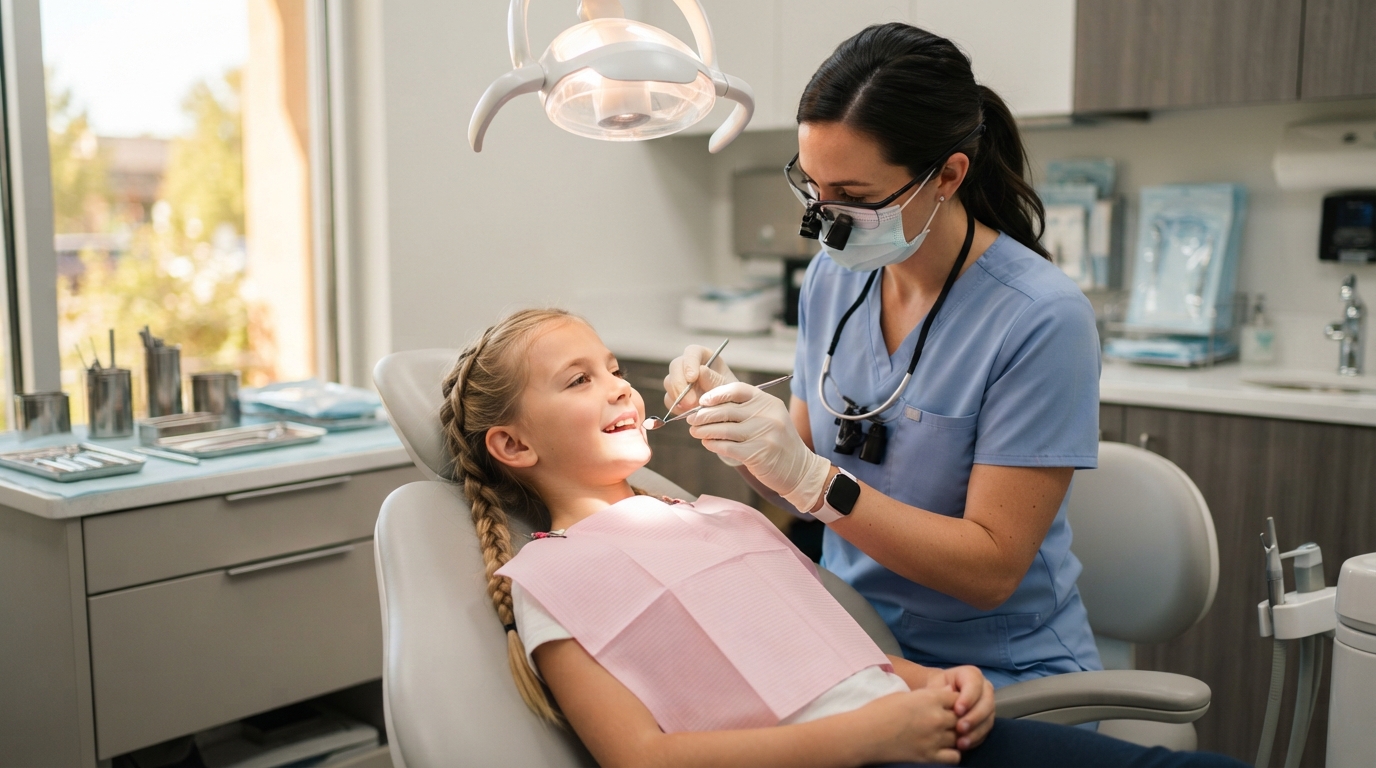
Family dentistry refers to dental care structured to serve patients of multiple ages, from young children through older adults, typically combining preventive, restorative, and cosmetic services within a single practice. This model reduces the need for separate pediatric and adult dental providers and supports continuity of care across a household.
Family dentistry typically includes routine exams, cleanings, cavity treatment, and restorative work, services that address the most common oral health needs across age groups. According to the American Dental Association, professional cleanings and comprehensive exams are generally recommended at least twice a year, with more frequent visits suggested for patients at higher risk of gum disease or decay. This recall schedule applies broadly, whether the patient is a young child receiving a first checkup or an adult managing long-term oral health.
What Family Dentistry Typically Covers
A family-oriented dental practice generally structures care around a few recurring categories rather than offering unrelated specialty services. Based on commonly listed offerings at practices of this type, the scope usually includes:
- Routine dental exams and professional cleanings
- Cavity treatment and tooth filling replacement or repair
- Restorative dentistry, including procedures aimed at preserving natural teeth
- Cosmetic dentistry options such as whitening or smile-focused treatments
These categories reflect the everyday needs of patients across age groups, from a child’s first cavity to an adult’s interest in cosmetic improvements. Because the same provider handles both preventive and restorative visits, records and treatment history stay consolidated rather than split across multiple offices.
How Visit Frequency Changes by Age and Risk
Not every patient needs the same recall schedule, even within a single household. The ADA’s general guidance suggests exam intervals that shift based on risk factors rather than a fixed calendar rule for everyone.
|
Patient Profile |
Typical Exam Interval |
Notes |
|
Healthy adult, low decay risk |
Every 6 months |
Standard bitewing X-ray interval often extends further |
|
Active gum disease or high decay risk |
Every 3 to 4 months |
Interval set case by case |
|
New patient, any age |
Initial exam, then set by findings |
Baseline imaging typically taken at first visit |
|
Child, first tooth or age one |
Within 6 months of first tooth, or by first birthday |
Establishes a developmental baseline |
This tiered approach explains why two members of the same family might be scheduled on different timelines even though both are patients at the same practice.
Why Centralized Care Matters for Households
Coordinating appointments for multiple age groups through one provider carries practical advantages beyond convenience. A single dental record system can track decay risk, prior restorations, and cosmetic treatment history without gaps that occur when records are split across providers.
- Scheduling for children and adults can often be aligned on the same visit day
- Treatment history stays in one chart, reducing repeated intake paperwork
- Risk-based recall intervals can be adjusted consistently as family members age
Residents of New Baltimore, MI searching for this type of coordinated care are generally looking for a provider who can manage routine prevention and occasional restorative or cosmetic needs without referring every case elsewhere. A practice built around general and cosmetic treatment categories, rather than a single narrow specialty, tends to fit that search pattern more directly.
Based in the USA, DiPilla Dentistry of New Baltimore handles dental care for patients across New Baltimore, MI, offering general, restorative, and cosmetic treatment categories under one practice structure.
Frequently Asked Questions
How often should a family schedule dental checkups? Most patients are advised to schedule exams and cleanings every six months, though higher-risk patients may need visits every three to four months based on individual findings.
At what age should a child have a first dental visit? The general guidance is a first visit within six months of the first tooth appearing, or by the child’s first birthday, whichever comes first.
Does family dentistry include cosmetic treatments? Many practices built around family care also offer cosmetic options such as whitening alongside preventive and restorative services, though the exact scope varies by provider.
Is restorative work part of a typical family dental visit? Restorative treatment, including cavity fillings and repairs, is commonly addressed during or following a routine exam when decay or damage is identified.
Appointment Details
Current office hours and contact information for DiPilla Dentistry of New Baltimore are published online for reference.